Price shown is On The Road Price: it includes VAT, first year VED, vehicle first registration fee, number plates and delivery. Lease estimate is based on a BCH calculation excluding VAT, 6+35 months payment profile, 10,000 miles per annum, excluding optional maintenance package. For comparison only, actual lease offers can differ significantly from the indication shown.
Real Range Estimation between 165 - 335 mi
City - Cold Weather *
230 mi
Highway - Cold Weather *
165 mi
Combined - Cold Weather *
195 mi
City - Mild Weather *
335 mi
Highway - Mild Weather *
210 mi
Combined - Mild Weather *
260 mi
Indication of real-world range in several situations. Cold weather: 'worst-case' based on -10°C and use of heating. Mild weather: 'best-case' based on 23°C and no use of A/C. For 'Highway' figures a constant speed of 70 mph is assumed. The actual range will depend on speed, style of driving, weather and route conditions.
The 'long distance suitability' is a 5-star rating that indicates how suitable a vehicle is for long trips. The rating is based on the 1-Stop Range: the total distance a vehicle can cover with one charging stop of 15 minutes, charging to at most 80%.
† This can only be achieved using a 3-phase grid connection. The majority of homes and charge points do not have this connection. In practice charge power will often be 7.4 kW, allowing for a charge time of 11h30m and a charge speed of 20 mph.
(Advertisement)
Performance
Acceleration 0 - 62 mph
4.5 sec
Top Speed
112 mph
Electric Range *
225 mi
Total Power
280 kW (375 hp)
Total Torque
395 lb-ft
Drive
AWD
Bidirectional Charging (V2X / BPT)
Vehicle-to-Load (V2L)
V2L Supported
Yes
Max. Output Power
1.5 kW AC
Exterior Outlet(s)
-
Interior Outlet(s)
1 x UK Socket (BS1363)
Vehicle-to-Home (V2H)
V2H via AC Supported
No
Max. Output Power
-
V2H via DC Supported
No
Max. Output Power
-
Vehicle-to-Grid (V2G)
V2G via AC Supported
No
Max. Output Power
-
V2G via DC Supported
No
Max. Output Power
-
Energy Consumption
EVDB Real Range
Range *
225 mi
Vehicle Consumption *
316 Wh/mi
CO2 Emissions
0 g/km
Vehicle Fuel Equivalent *
128 mpg
WLTP Ratings (TEL)
Range
325 mi
Rated Consumption
248 Wh/mi
Vehicle Consumption
218 Wh/mi
CO2 Emissions
0 g/km
Rated Fuel Equivalent
163 mpg
Vehicle Fuel Equivalent
185 mpg
WLTP Ratings (TEH)
Range
296 mi
Rated Consumption
267 Wh/mi
Vehicle Consumption
240 Wh/mi
CO2 Emissions
0 g/km
Rated Fuel Equivalent
151 mpg
Vehicle Fuel Equivalent
169 mpg
TEL = Test Energy Low | TEH = Test Energy High Rated = official figures as published by manufacturer. Rated consumption and fuel equivalency figures include charging losses. Vehicle = calculated battery energy consumption used by the vehicle for propulsion and on-board systems. NOTE: The fuel equivalency figures are shown in IMPERIAL MPG. Figures in US MPG will differ significantly.
Real Energy Consumption Estimation between 212 - 430 Wh/mi
City - Cold Weather *
309 Wh/mi
Highway - Cold Weather *
430 Wh/mi
Combined - Cold Weather *
364 Wh/mi
City - Mild Weather *
212 Wh/mi
Highway - Mild Weather *
338 Wh/mi
Combined - Mild Weather *
273 Wh/mi
Indication of real-world energy use in several situations. Cold weather: 'worst-case' based on -10°C and use of heating. Mild weather: 'best-case' based on 23°C and no use of A/C. For 'Highway' figures a constant speed of 70 mph is assumed. The energy use will depend on speed, style of driving, climate and route conditions.
(Advertisement)
Safety (Euro NCAP)
Safety Rating
Adult Occupant
89%
Child Occupant
85%
Rating Year
2025
Vulnerable Road Users
80%
Safety Assist
79%
For more details on the safety rating of this vehicle, visit euroncap.com
* = estimated value. Average energy consumption and range based on moderate drive style and climate. Real-life values may differ significantly. Pricing information might not be actual for some regions. No rights can be derived from the information on this site.
Similar electric vehicles
Lexus RZ 500e £6,300 more expensive 15 mi more range Same acceleration 5% more energy efficient 6% faster rapid-charging
DS Automobiles N°7 FWD £805 less expensive 15 mi more range 71% slower acceleration 3% more energy efficient 15% slower rapid-charging
Audi Q6 Sportback e-tron £13,070 more expensive 25 mi more range 56% slower acceleration 4% more energy efficient 47% faster rapid-charging
Range comparision based on electric range only. Rapid charging comparison based on rapid charge rate. Comparisons can be based on estimates.
Home and Destination Charging (0 -> 100%)
Charging is possible by using a regular wall plug or a charging station. Public charging is always done through a charging station. How fast the EV can charge depends on the charging station (EVSE) used and the maximum charging capacity of the EV. The table below shows all possible options for charging the Subaru E-Outback AWD. Each option shows how fast the battery can be charged from empty to full.
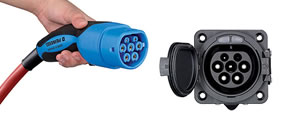
Type 2 (Mennekes - IEC 62196)
Charging Point
Max. Power
Power
Time
Rate
Wall Plug (2.3 kW)
230V / 1x10A
2.3 kW
36h30m
6 mph
1-phase 16A (3.7 kW)
230V / 1x16A
3.7 kW
22h45m
10 mph
1-phase 32A (7.4 kW)
230V / 1x32A
7.4 kW
11h30m
20 mph
3-phase 16A (11 kW)
400V / 3x16A
11 kW
7h45m
29 mph
3-phase 32A (22 kW)
400V / 3x32A
22 kW †
4 hours
56 mph
† = Limited by on-board charger, vehicle cannot charge faster.
(Advertisement)
Rapid Charging (10 -> 80%)
Rapid charging enables longer journeys by adding as much range as possible in the shortest amount of time. Charging power will decrease significantly after 80% state-of-charge has been reached. A typical rapid charge therefore rarely exceeds 80% SoC. The rapid charge rate of an EV depends on the charger used and the maximum charging power the EV can handle. The table below shows all details for rapid charging the Subaru E-Outback AWD.
Max. Power: maximum power provided by charge point
Avg. Power: average power provided by charge point over a session from 10% to 80%
Time: time needed to charge from 10% to 80%
Rate: average charging speed over a session from 10% to 80%
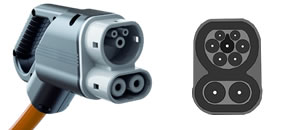
Combined Charging System (CCS Combo 2)
Charging Point
Max. Power
Avg. Power
Time
Rate
CCS (50 kW DC)
50 kW
50 kW
63 min
150 mph
CCS (150 kW DC)
150 kW
110 kW †
29 min
320 mph
CCS (350 kW DC)
150 kW †
110 kW †
29 min
320 mph
CCS (500 kW DC)
150 kW †
110 kW †
29 min
320 mph
This vehicle does not support Plug & Charge
† = Limited by charging capabilities of vehicle
Plug & Charge: allows for automatic initiation of a charging session at supported CCS charging stations in accordance with ISO 15118.
Actual charging rates may differ from data shown due to factors like outside temperature, state of the battery and driving style.
Subaru Claimed Specifications
The table below shows the claimed specifications from the manufacturer for charging the Subaru E-Outback AWD. The specifications can differ from the table above for a variety of reasons. If real-world charge tests are available, these differences can be signifcant. If no real-world tests are available, the table above will be based on the manufacturer specifications as per the table below.
Max. Power: maximum charge power during charging session
Charge From: battery percentage (% SoC) where charging session is started
Charge To: battery percentage (% SoC) where charging session is ended
Time: time needed for charging session
Subaru Claimed Specifications
Max. Power
Charge From
Charge To
Time
150 kW
10 %
80 %
30 min
Long Distance Suitability
How suitable an electric car is for long trips depends not only on the range. How quickly the car can charge plays an almost equally important role. Whether an EV is suitable for long trips depends on the battery capacity, efficiency, and fast charging capability.
To easily compare cars among each other, a benchmark has been established that combines these factors into the total distance a vehicle can cover with one 15-minute charging stop: the '1-Stop Range'. Based on the 1-Stop Range, the 5-star rating is determined. The result of the benchmark is shown in the graph below.
1-Stop Range
+
Based on the driving profile and assumptions below, the 1-Stop Range is determined. The sum of the distance covered in both trip legs is the 1-Stop Range. For vehicles that cannot fast charge, only the distance from the first leg applies.
Driving Profile
Start with a fully charged battery
Drive until 10% battery charge is reached (leg 1)
Fast charge: 15 minutes
Drive until 10% battery charge is reached (leg 2)
Assumptions
Speed, climate, and external conditions based on Real Range Highway
No time required for starting and stopping the charging session
The charger can always supply the charging power requested by the vehicle
The battery is in optimal condition
In practice, it is impossible to exactly meet the driving profile and assumptions. The benchmark is therefore only suitable for comparing vehicles under standardized conditions.
5-Star Rating
+
The 1-Stop Range describes the distance the vehicle can cover with one 15-minute charging stop. To clearly show the impact of temperature, the 1-Stop Range is determined for three weather conditions. These weather conditions are identical to those in the Real Range benchmark. The 1-Stop Range under average conditions determines the number of stars awarded. The star rating provides a quick way to assess whether a car is suitable for long trips compared to other cars.
Assignment of Stars in 2026
0
less than 124 mi (200 km)
1
from 124 mi (200 km) to 202 mi (325 km)
2
from 202 mi (325 km) to 280 mi (450 km)
3
from 280 mi (450 km) to 357 mi (575 km)
4
from 357 mi (575 km) to 435 mi (700 km)
5
more than 435 mi (700 km)
Star ratings are based on thresholds in kilometers. Mile values shown for reference.
Vehicles with a result between these threshold values receive a rating based on a linear scale. Haalf stars are possible.
Revision of Rating
+
Annual Revision
The technology of electric cars is developing rapidly. To ensure that the rating remains relevant, the threshold values are evaluated annually. These threshold values apply to all vehicles, including used vehicles. This makes it possible to compare each car against each other based on the current state of technology.
1-Stop Range
The underlying 1-Stop Range is not revised annually. The total distance that a specific vehicle can cover with one 15-minute charging stop remains the same. If the vehicle itself receives an update that changes the 1-Stop Range, then this change will also be reflected in the rating.
Subaru E-Outback AWD
2.5 / 5
0
1
2
3
4
5
190 mi
2h 47min
15 min
96 mi
1h 24min
167 mi
2h 26min
15 min
84 mi
1h 14min
250 mi
(3h 55min)
148 mi
2h 10min
15 min
75 mi
1h 5min
222 mi
(3h 30min)
0 mi
100
200
300
400
Mild Weather
286 mi
1-Stop Range
Average Conditions
250 mi
1-Stop Range
Cold Weather
222 mi
1-Stop Range
All about the Subaru E-Outback AWD
Pricing
The Subaru E-Outback AWD has an On The Road Price (OTR) of £49,995. The OTR Price includes VAT, first year of VED, vehicle first registration fee, number plates and delivery.
Drivetrain and Performance
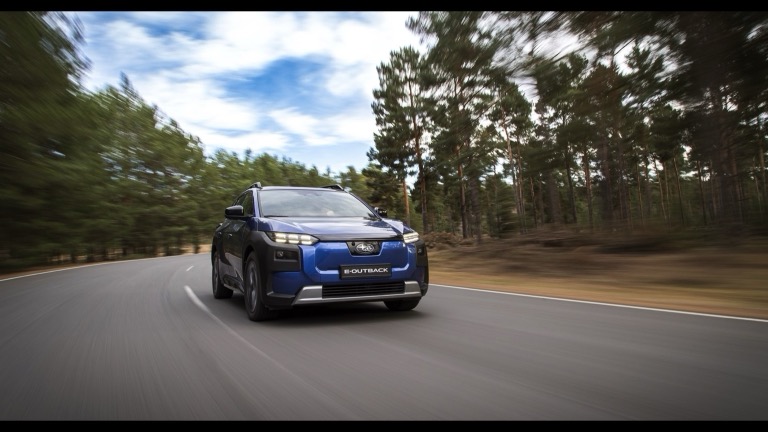
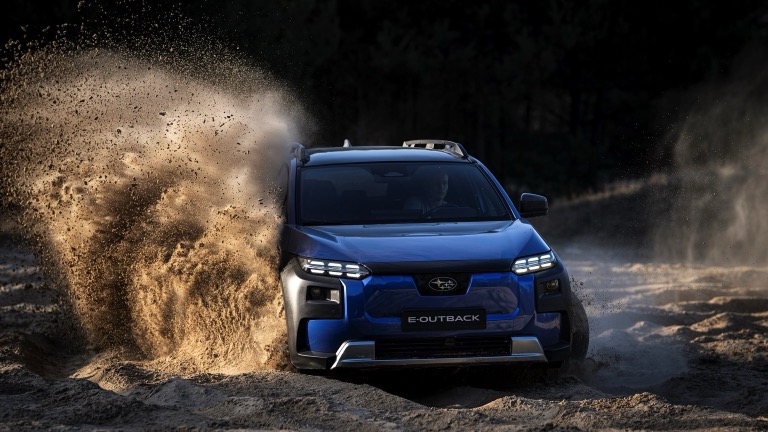
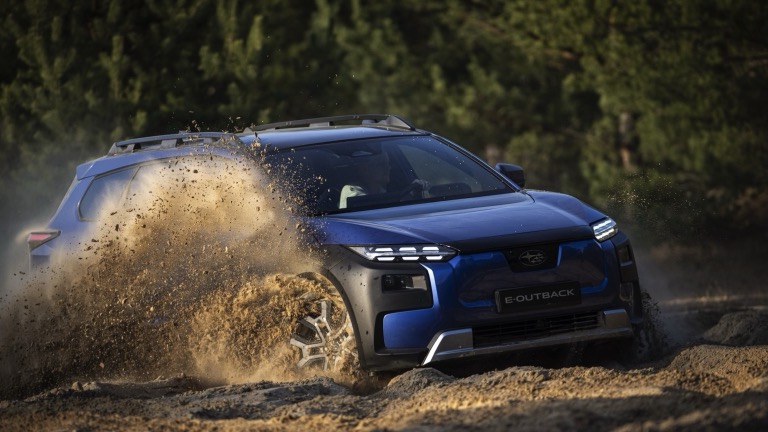
The Subaru E-Outback AWD is a full electric vehicle (BEV). The maximum power of the Subaru E-Outback AWD is 280 kW (375 hp). The maximum torque is 395 lb-ft. The Subaru E-Outback AWD is all wheel drive and can accelerate from 0 to 62 miles per hour in 4.5 seconds. The top speed is 112 mph.
Battery and Charging
The battery of the Subaru E-Outback AWD has a total capacity of 74.7 kWh. The usable capacity is 71 kWh. An estimated range of about 225 miles is achievable on a fully charged battery. The actual range will however depend on several factors including climate, terrain, use of climate control systems and driving style.
For example: sustaining high speeds in cold weather could result in a range of around 165 mi. However, driving at low speeds in mild weather will increase the range to around 335 mi.
Charging is done using a Type 2 connector and the on-board charger has a maximum power of 22 kW. This charges a fully depleted battery back to full in around 4 hours. However, a 3-phase grid connection is needed to achieve this. The majority of homes and charge points currently do not have this connection. In most cases the maximum charging power will be 7.4 kW, allowing for a charge time of 11 hours 30 minutes and a charge rate of 20 mph. Charging the car using a regular wall plug will take around 36 hours 30 minutes.
Rapid charging is possible through a CCS connection. The maximum rapid charge power is 150 kW. The battery can't be charged continuously at this power. In an average rapid charge session the average charge power will be around 110 kW. This charges the battery from 10% to 80% in around 30 minutes. A rapid charge like this will add about 155 miles of range.
Energy Consumption
The estimated combined (motorway and city) energy consumption of the Subaru E-Outback AWD is about 316 Wh per mile. By comparison, this energy consumption is the equivalent of a fuel consumption of 128 mpg in a traditional petrol car.
The actual energy consumption will depend on several factors including climate, terrain, use of climate control systems and driving style. For example: sustaining high speeds in cold weather could result in an energy use of around 430 Wh per mile. However, driving at low speeds in mild weather will increase the efficiency to about 212 Wh per mile.
CO2 Emission
The Subaru E-Outback AWD emits no CO2 during driving. This only includes direct emissions from the vehicle itself. The energy needed to charge the battery might have been (partly) generated by the use of fossil fuels. Vehicles with an internal combustion engine will always emit CO2 during driving. Additionally, CO2 is emitted during the production and transport of fossil fuels.
More information from Subaru
The link below will open the page of the E-Outback on the official Subaru site.

 Lexus RZ 500e
 DS Automobiles N°7 FWD
 Audi Q6 Sportback e-tron